 lucky instar
 random bee - Dufourea, the short-faced, wide-ranging specialists
DATE
Welcome to 'random bee', a short writing series where I choose a random page in the book "Bees of the World: A Guide to Every Family" by Laurence Packer, then research it and do a short write up.
DATE
Welcome to 'random bee', a short writing series where I choose a random page in the book "Bees of the World: A Guide to Every Family" by Laurence Packer, then research it and do a short write up.Today's random bee is:
Genus: Dufourea
Family: Halictidae
Subfamily: Rophitidae

This is a group I don't know anything about!
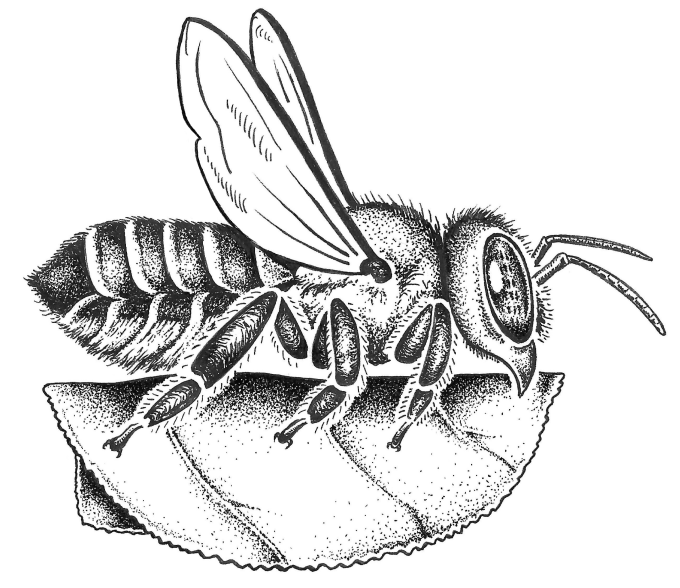
There are 160 species in the genus Dufourea. They're found all across North America and seem to be especially abundant in California (57 species there). They are also found in alpine regions of Europe, including Iberia. Dufourea tend to the small side, not unlike Macrotera that we talked about before, typically being 3.5-11 millimeters long. They have longer, narrower bodies and tend to be dark-colored, especially black, but rarely a species will be bright metallic green or blue. Some of them have a reddish abdomen (also like Macrotera).
The antennae are set very low on the face. Dufourea tend to be specialist bees and feed on few flower species. Some in the US specialize on pickerelweed and bee balm. Pickerelweed is an aquatic plant with pretty purple flowers, so you might need to be in a canoe to see the bee visting it, Dufourea novaeanglieae. Like other species in the sweat bee family, they are ground nesters with shallow nests.

Bees (and other insects) have a distinct part of the face called the clypeus, which I think of as the 'mustache' of the face. It's a typically bare, broad region of the face below the eyes and above the mouthparts. There are lots of species that are distinguished by different features of the clypeus. Dufourea's clypeus tends to be short and wide, which is why they are called the short-faced bees.
Males tend to have really long antennae (this is true for a lot of bees though), and the segments are kind of thick, even bulging out in the middle a bit to give them a knobby look. The females, like a lot of bees, have pollen-collecting hairs on the back legs. Sometimes males have a protruding clypeus that sticks out a bit.
There isn't a ton of information of Dufoerea ecology because not many people study them, which is common for small bees. It seems most research on these bees is about documenting which species are where, which I guess is the first step to understanding anything about a species. But there is much less work on the actual ecology of many of them - what they eat, what they do, etc.

Source:
Dumesh, Sheila, and Cory S. Sheffield. "Bees of the genus Dufourea Lepeletier (Hymenoptera: Halictidae: Rophitinae) of Canada." Canadian Journal of Arthropod Identification 20.20 (2012): 1-36.