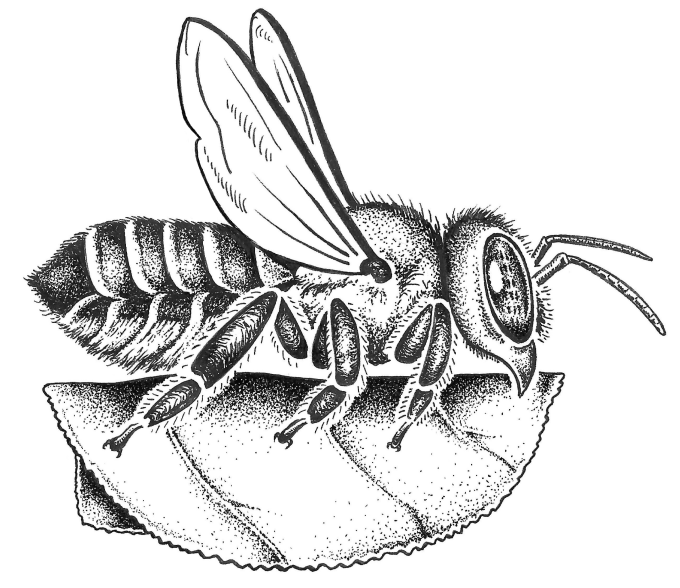
 lucky instar
If you were coming in the fall,
I'd brush the summer by
With half a smile and half a spurn,
As housewives do a fly.
If I could see you in a year,
I'd wind the months in balls,
And put them each in separate drawers,
Until their time befalls.
If only centuries delayed,
I'd count them on my hand,
Subtracting till my fingers dropped
Into Van Diemen's land.
If certain, when this life was out,
That yours and mine should be,
I'd toss it yonder like a rind,
And taste eternity.
But now, all ignorant of the length
Of time's uncertain wing,
It goads me, like the goblin bee -
That will not state its sting.
random bee - Macrotera: goblin bees & Emily Dickinson
August 9, 2026
Welcome to 'random bee', a short writing series where I choose a random page in the book "Bees of the World: A Guide to Every Family" by Laurence Packer, then research it and do a short write up.
August 9, 2026
Welcome to 'random bee', a short writing series where I choose a random page in the book "Bees of the World: A Guide to Every Family" by Laurence Packer, then research it and do a short write up.Today's random bee is:
Genus: Macrotera
Family: Andrenidae
Subfamily: Panurginae
Tribe: Perditini
Goblin bees are a low-level enemy in Final Fantasy that you have to grind fighting to level up early in the game - just kidding, it's a real-ass insect that lives in the deserts of US and Mexico.
This is a genus I'm familiar with because it lives in my region of the world, and almost exclusively in that region! Macrotera are also called goblin bees and are tiny species in the family Andrenidae, which are solitary mining bees. They are found in the southwestern and western US and through most of Mexico. Macrotera are mostly very small (~2 mm) but some are medium sized (16 mm).

They used to be lumped in with the genus Perdita, or fairy bees, which are an incredibly diverse group of very small bees. They are now separated due to DNA evidence. There are 31 species total.
Macrotera tend to be specialists and visit very few flower species. Common plants they visit are globemallow or cacti, including prickly pear cacti. Many of them are dark colored with a reddish abdomen.
Ok, goblin bees?!? Macrotera is apparently Greek for "great monster", an amazing moniker to give an insect that doesn't get much larger than 5 mm in length (I love entomologists). They're called goblin bees because some have kind of a unique large, boxy head that you don't see often in bees. The head and mandibles are a bit oversized, and their large eyes are pushed out to the sides of the head. They do have kind of a Stitch look to them.
They're so small that you can't really appreciate the goblin-ness without a microscope. If you live in the desert you've probably seen globemallows with their orange flowers. If you look inside, you are likely to see a Macrotera with a red abdomen.
Like most of the Andrenid bees, Macrotera also nest underground and they produce a waxy brood-cell lining in their nests.
Only one species has been really extensively studied, and that is Macrotera portalis (no common name exists), which can be found around New Mexico! Females will share a nest with about a dozen individuals, and they reuse nests over several years.

What's most interesting about this species is the males. Males comes in two types of sizes: normal males and super-buff swole males. The normal males look like other bees and have wings, so they can mate outside of the nest.
The buff males have with gigantic heads exclusively for fighting other males, and they do combat in the nest, sometimes to the death. They cannot fly and have reduced eyes. They fight other large-headed males for access to females. These giant males only hang out in the nest and will mate with females as they are building nest cells. There is a 1:1 ratio of normal to chad males.
Since the normal males can leave the nest, they don't have to compete with the giant males. The two types must be equally successful, since neither type has gone extinct.
Two to 29 females share a nest but they make their own nest cells, although they may share a burrow or tunnel. The nests are shallow, reaching 15 cm at most. Main tunnels will go straight down into the dirt, and each nest cell is horizontal. The females dig by using their mandibles and pushing soil backwards with their legs.
Each nest cell holds one egg, and each cell is lined with a water-resistant lining by the female. The bee brushes the lining from her body onto the walls of the cell.
Like a lot of desert bees, Marcrotera tend to emerge after rainfall, especially after the late summer monsoon rains. Many solitary bees only live for a few weeks, so they have to time their emergence with the availability of flowers.
Holy shit, apparently Emily Dickinson used the phrase goblin bee in a poem - this is news to me. Here it is reproduced below.
if you were coming in the fall
Emily Dickinson
Please start using "it goads me like the goblin bee" in your daily speech.
That's crazy. I can't imagine the average reader would be familiar with goblin bees as a taxonomic group, so I wonder how people interpret this.
How do you interpret this poem? Actually, I wonder if the group was called goblin bees before or after this poem was published? I would look into that, but I don't want to do any more deep dives for this post.
Have you ever come across a poem that relates to your field or hobbies?
