 lucky instar
 terms of ecology: committing floral larceny
DATE
DATE
Get in, loser, we're stealing nectar.

Today we are diving into the wonderful world of ecology, a field of biology that deals with the interactions between organisms and their ecosystems. It is a large field that overarches biological networks, population genetics, species interactions, and many others.
Like any science, it is full of jargon. Here I'm going to describe some terms specific to ecology that make me laugh.
floral larceny
More typically called nectar robbing, this is a type of foraging behavior where the animal bites a hole in the base of the flower to access the nectar, thereby bypassing pollination by avoiding contact with the pollen-holding parts of the plant. The thief gets all the benefits of the interaction while the flower receives nothing, losing its valuable nectar enticement. Rude!
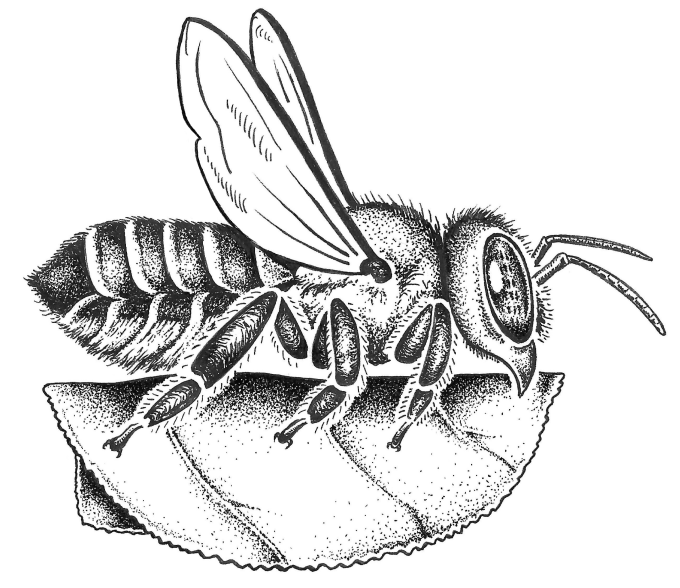
It is also called floral larceny for some unconceivable reason, which is a much funnier term. This is usually done by bee species that are too large to enter the flower (carpenter bees, bumble bees), so they just bite a hole for quick access. Some other insects like wasps and ants do it, and a couple of birds including hummingbirds and a group named specifically for this habit called flowerpiercers. Some bats and at least one squirrel also do this.
I had never heard of flowerpiercers before, but they are a songbird from South America. Their beaks are like pincers at the very tip, with a little bit of a hook. Their colors range from black to brown to blue.
The range of effects on the plant is variable, reaching from neutral to negative. It causes a negative effect when the robber removes all or most nectar, causing the true primary pollinator to stop visiting that particular plant, essentially preventing it (or reducing its chances greatly) of being pollinated.
When birds commit larceny, they can damage the flower because they're so big, so this causes an obvious negative.
The flowers have do some defences. They can produce nectar at certain times of day when their primary pollinator (not the robber) is active. Petals can contain secondary compounds in the tissue that deters animals that try to bite through it. The amount of sugar concentration in nectar varies with plant species - having a very dilute nectar can dissuade thieves because it is not longer worth it.
Some species have special flower shapes to prevent robbing, like tightly packed petals or have tough tissue barriers around the flower base.
charismatic megafauna
When you think about wildlife conservation, what do you think of? Tigers? Pandas? Elephants? Cheetahs, giraffes, polar bears, wolves, gorillas, koalas? How many endangered insects do you know of? How many endangered plants?
Unfortunately we are all subject to biases when it comes to species. It's hard not to care more about the large, fuzzy ones that you can see, and whose behavior you can maybe relate to.
Megafauna refers to any animals that are large, relative to other animals (animals you can see easily - there's a reason there are no dinoflagellate zoos). And charismatic has an obvious meaning - species that have widespread appeal or are symbolic (mammals, mostly. some birds.).
The term refers to flagship species in conservation, and they are the species that bring in the most funding for conservation, too. There's a reason World Wildlife Fund's logo is a panda. It's much easier to spread awareness and incite passion when using a story about elephant conservation.
It's not all negative, though. Many of these same species serve as 'umbrella species'. As a result of their large size, large regions of land and habitat have to be preserved to save them (think of saving elephant or tiger habitat - entire parks are dedicated to these animals). As a result, anything else that lives in that habitat gets preserved, too. The megafauna serve as an umbrella to protect all the other species below them.
landscape of fear
This was a term coined initially I think with the wolf reintroduction into Yellowstone National Park in the US, but it applies to many large predator interactions.
The general idea of the wolf story is that wolves were exterminated from large parts of the US following colonization. When they were reintroduced, massive ecosystem changes took place. Wolves obviously preyed on deer and elk, and these grazers greatly affect the plant ecosystem by chomping down young saplings, altering the forest structure. So, some herbivore control affects forest ecosystems.
But what was interesting is that only the presence of wolves also had a measurable effect. Even if wolves ate zero elk, their presence changed how the elk behaved. Elk were more alert. They spent more time looking up then they did with heads down and chomping plants. The fear of predators reduced how much they could eat.
Predator presence changes how prey animals behave in other ways, including in how they move across the landscape, their energy expenditures, etc. Prey perceive their risk to be higher in different regions based on habitat, tree and shrub cover, etc, so their behavior also varies with how they perceive this risk. Some prey species have developed a mental map of their habitat where they judge their predator risk to be higher or lower across the landscape.
sneaky male
This one is related to mating systems. In some (mostly vertebrate) animals, males have two behavior options when seeking mates. One is obvious and involves the male using some force of strength or a mating dance, etc to get access to females. This occurs in all deer which use their antlers to fight other males, or in bird species that have an elaborate courtship dance with bright feathers. Deer with large antlers or birds that have bright feathers and complex dances are indicating something about their fitness ability to females.
In other species, this male competition exists but there is a second strategy also. Sneaky males behave in different ways by avoiding the physical competition aspect. They are usually smaller and might lack any bright coloration. In male-competition species, the males may have several females they are courting at once, or are in control of a harem of females. This is a lot of females to keep track of, and the aggressive male can't keep his eye on every female at all times.
The sneaky male literally comes in secretly and mates with a female while the tough male is distracted, then quietly slips away. The tough male may never notice. This way, the sneaky male propagates its genes over generations.
Animals that do this include the well-known spiny lizards, several fish species, cuttlefish (a cephalopod, like a squid), elephant seals, baboons and more.
tendril perversion

I learned about this one recently from a mastodon post.
It can refer to any case where the direction of twisty helical structures changes from left-handed to right-handed, or vice versa. It can happen in phone cords, but I'm referring to it in the tendrils of plants.
Plant tendrils are used in climbing plants for support and attachment. As the plant grows, the tendril reaches out until in contacts a surface to begin twisting around to.
The tendril often grows in a twist but it sometimes randomly switches handedness, but it's not known what causes this. Maybe it's to reduce tension in the structure.
Charles Darwin first noticed it in 1865, where he commented that a tendril "invariably becomes twisted in one part in one direction, and in another part in the opposite direction". Apparently it has been studied at the physics-level and is related to efficient energy conservation.
royal jelly
Maybe most people have heard this one. It sounds like some kind of juicing diet fad. (and it kind of is), which it why I think it's funny.
Royal jelly is a secretion from honey bees used to develop a larvae into an adult queen. It comes from the head glands of worker honeybees and is fed to larvae. It's technically fed to all larvae, whether they are workers, queens, or drones, but only at the beginning of their life. Future queens are fed the jelly throughout their entire development.
It's mostly water with some protein, simple sugars, and some fatty acids, along with very trace amounts of other things. What is interesting is that this means queens are controlled through outside sources and not through their genetics. No egg laid is genetically meant to be a queen - it isn't until its fed the royal jelly for a long time that it happens. Something about the jelly appears to trigger ovary development (workers are sterile).
Royal jelly is also used an alternative medicine in humans and is sold as a supplement with alleged health benefits. People collect it from the queen cells where workers deposit it for the growing larvae. It is supposed to have antioxidant effects and reduces cholesterol and supports the immune system. Some say it aids wound healing when applied to the skin. I don't think there's any actual evidence for supporting any of this.
Apparently the Vegetarian Society considers it to be non-vegan, which makes sense because they also consider honey to be non-vegan.
red queen hypothesis
The term comes from Lewis Carroll's Through the Looking-Glass. Alice is playing a living chess piece on a giant chessboard and begins to run to make it to Eighth Square, but realizes that the objects around her don't seem to move no matter how fast she runs.
The Red Queen tells Alice: "Now, here, you see, it takes all the running you can do, to keep in the same place."
The hypothesis is applied to evolutionary biology and is the idea that species must constantly adapt and evolve in order to survive and avoid extinction. For a species to hold its place in an ecosystem it must constantly evolve because the organisms it interacts with (its prey and its predators, its competitors) are also evolving themselves. It's like when the wolf's speed has to evolve to match the deer's speed - they are in an evolutionary arms race. One species evolves venom and its prey evolves venom resistance, so the venom and the resistance keep changing over time as both groups adapt and evolve.
There is a famous book written on the topic The Red Queen: Sex and the Evolution of Human Nature by Matt Ridley, 1993, where the theory is discussed relative to the adaptive benefit of sexual reproduction (as opposed to just reproducing asexually).
What kind of ridiculous terms exist in your field? Any jargon that sounds insane from an outsider's viewpoint?