 lucky instar
 my neighbor is a spider-hunting wasp:
insects of the US southwest
August 2, 2026
I am an entomologist and love insects. I live in the desert southwest of the US, which is surprising to many a biological hotspot for insect diversity (especially bee diversity!). Many people think of deserts as barren landscape, but they are full of diverse life.
Here I will be introducing you to some unique insects local to my area, and that I'm familiar with.
Warning: there are pictures of insects, spiders, and centipedes below.
Feel free to not read if you are squeamish about this. But even if you don't like bugs, I would really encourage you to learn about some of these insects - they're just animals. And they have really fascinating behavior.

This is a big-ass wasp that people living in the desert are familiar with seeing. There are several similar species but I'll be focusing on Pepsis grossa, which is incidentally the state insect of New Mexico and also fairly common.
It can be up to 2 inches long, is typically black or iridescent green on the body, and has bright orange wings - you really can't miss it! It notoriously has one of the most painful insects stings, allegedly - that one youtube guy that gets stung by stuff has a video on it, I'm sure.
Hawk wasps in general are fascinating because they are parasitoids - animals whose offspring parasitize another living animal. An adult female hawk wasp lays her eggs on another insect, like on a tarantula. The eggs hatch, and the carnivorous larvae then eat the host. Overall its a harrowing situation that undoubtedly inspired the movie Alien. It's not even that unique of a situation - a ton of wasps and other insects do this.
This means that the adult female has to secure a host for the babies. In this case, hawk wasps are specialists on taking down tarantulas, which are often as big or bigger than the wasps. Step one is subduing your host, which is where the venomous sting comes in handy. The wasps sting tarantulas, which paralyzes them, and then they begin the long haul of dragging a bigass spider into a nest, which is usually a burrow.
As if that wasn't horrifying already, the spider stays alive but paralyzed through the ordeal. If it was dead the body would decay too fast and the larvae couldn't feed from it. There are lots of different parasitoid wasps that specialize on different prey - spiders, caterpillars, cockroach egg cases, etc. It's a diverse world out there.
Despite this, the tarantula hawk wasp is pretty mild in its interactions with humans. I've seen them dozens of times and never had a problem - they mind their own business. They don't defend a hive like some of the other social wasps do - yellow jackets, hornets, etc - so they aren't territorial and aggressive.

Now we move down to our slightly less horrifying (but still sort of horrifying) wasps. Cuckoo wasps are a really big group that are not well-defined because they're really hard to study and no one really studies them (aka no one wants to pay me to study them). But they are all parastioids also and many of them are metallic green or blue, earning them the moniker jewel wasps. Some are green with a shiny reddish abdomen. They're really beautiful and quite tiny.
Unlike similarly colored bright insects, if you look at the surface of their exoskeleton, it is marked by hundreds of tiny pits and dents - they aren't smooth. Their exoskeletons are extremely tough and difficult to pierce - probably a good defense if you are a parasitoid of stinging insects, which they are. Cuckoo wasps parasitize the nests of bees, which can be aggressive about intruders. The wasps can also curl up into a tight ball as a defense - good armor against stings.
They focus on getting inside solitary bee nests and surreptiously laying an egg inside the bee's nest cell. When the egg hatches, it can eat the pollen provision the mother bee left and/or the bee larvae itself.

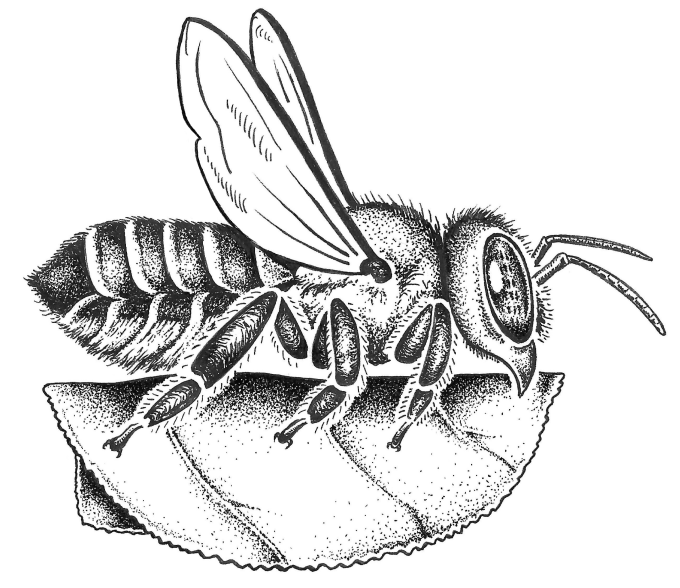
Here is another metallic green insect but one that leads an honest life. Sweat bees are pretty common where I live and found in large numbers. They also have an appealing shiny green exoskeleton. There are many different species but the one I am most familiar with is in the genus Agapostemon, so I will focus on those.
Like most bees, they are a solitary species, meaning they have no hive, no Queen, no workers, etc. It is one female building a nest and laying eggs. They typically nest underground in a burrow or hole of any kind - also pretty common for solitary bees. One way they do differ from other solitary bees is that they form nest aggregations, where females will nest close together. Despite their commonness they are not studied very well, probably because they don't provide any direct benefit to the agricultural industry (even though they are pollinators), so we don't actually know that much about them.
The males of Agapostemon species are distinct, with a striped abdomen. They are small bees (0.25 - 0.5 inches), smaller than a honey bee. They are called sweat bees because they are sometimes attracted to humans' sweat and will try to drink from it on your skin to get the salts and minerals. Personally, I think they should have been called jewel bees. They do have stingers (females only, as for all insects), but they're so small I can't imagine it would hurt too much.

An extremely common moth that most people in the US have probably seen before. There are other similar sphinx moth species in other regions like the UK that are also common. It's pretty big for a moth so it's very noticeable! The abdomen is huge and fuzzy, the wings have an appealing pink coloration underneath, and the tongue (or proboscis) is extremely long. They often hover in front of flowers like hummingbirds to drink nectar.
This particular species is really common but is still one of my favorite insects (I guess I root for the underdog). They are studied really well but mostly at the caterpillar stage, primarily because they are known for eating crops! The caterpillars are also unique in having different color morphs - brown, black, or green - so this is studied at the genetic level a lot. When they metamorphosize, the adults all look the same.
I'm interested in them personally because they can fly really long distances, so I want to see how interconnected their populations are genetically. It's amazing that they can be found at both sea-level deserts and at the tops of mountains 9,000ft in coniferous forest habitat. I would like to know if they maintain gene flow across these very disparate habitat types.

I suppose I would be remiss if I were not to include everyone's favorite insect, butterflies. Instead of focusing on the big, showy ones (like monarchs), I'm going to focus on a tiny, discrete one! The western pygmy blue is one of the smallest butterflies in the world, and the smallest butterfly in North America. It's about the size of my thumb nail. Yet, its extremely common and I see it in my backyard every year.
They have a crazy distribution that includes most the US, Mexico, and Venezuela. They are especially common in the southwest US. Adults lay their eggs on vegetation, with the white eggs being 0.5 millimeters in size. Eggs hatch into yellow-green caterpillars that feed for about 1 week before metamorphosizing.
In some regions it is active year-round, and in other areas it will migrate during the winter. Pygmy blues have recently made their way to Florida. They are so tiny that its likely wind gusts and currents have moved them across the continent, as there are no recorded intermediate populations.

I would also be remiss if I didn't include a bumble bee (some of my personal favorites). Everyone loves bumble bees (BBs), right? Hunt's bumble bee is a special one found in the western half of the US and down into Mexico, and is present at a variety of altitudes, including deserts and mountain peaks both. Bumble bees, with their large bodies and fuzziness, are especially suited to arctic and alpine habitats, so it's a bit surprising they can make it in the desert.
Hunt's bumble bee has a distinctive neon orange stripe on the abdomen, which is not uncommon for bumble bee species; the central bumble bee also has one. Bumble bees are kind of distinctive for having different tongue lengths among species, which roughly correlates to which kind of flowers they can feed from. Long flower tube = long tongue needed to get at the nectar. But Hunt's BBs are not specialists and will feed from most flowers; correspondingly they have a medium tongue length of about 5-6 millimeters. Other BBs at the other end of the tongue spectrum can reach lengths of about 12 mm.
Like all BBs, they have a year-long hive with a Queen and workers, nesting underground and storing nectar in honey pots. No BBs make honey like honey bees do.
Special Arthropods:
Even though this post is about insects, I would like to include some interesting arthropods. Insects are a specific group of arthropods that have 6 limbs and exoskeletons. Arthropods are just the larger category that includes insects as well as arachnids, crustaceans, and myriapods (millipedes, etc), and others.

The goliath of centipedes, an adult desert centipede cannot be mistaken for anything else, and the last place you want to be surprised by one is in your house (where they often end up).
A house centipede is NOTHING compared to this behemoth. They are an angry red with yellow limbs, and most devastatingly, move insanely fast. I think a lot of animal would be less scary if they just didn't move so fast. But this centipede is a speed racer and starts flailing all over the place as soon as you uncover it from the furniture in your house (or maybe that's just my experience?). Still, they are really amazing animals.
Like other centipedes, they have mandible-like structures called gnathosomes and so can bite. Many also have venom glands, and the desert centipede bite is notoriously painful (probably youtube has evidence for this). It has never caused any known human deaths, though. Because they get so big, they can prey on lots of different things, including insects, small lizards and toads, and even mice, which is terrifying.
These large arthropods lay eggs and molt their exoskeleton as they grow. The female will protect the eggs and coil around them - parental care! It can live for a really long time for an arthropod, up to a decade. Overall it's a little terrifying but kind of amazing at the same time, right? I'm happy I share the earth with you, desert centipede.

You know I was gonna talk about at least one spider.
Deserts are one of the places known to host tarantulas. This one is fairly common out in the Chihuahuan Desert, but I've never seen it around a residential area. They are especially common after rains in the summer and you can see them crossing the roads en masse if you drive away from urban areas a bit.
I think tarantulas are really beautiful but that's mostly because they are slow and seem gentle. If they moved really fast, that would be a different story.
Even though 'bronze' is in the name, they are usually completely black, with some orange (bronze-ish?) sparse hairs on the abdomen. They get to be about 2 inches in body length. The Tucson bronze lives in burrows and is nocturnal, coming out at night to hunt. Like most tarantulas, they are shy and typically unaggressive. Also like other tarantulas, they have urticating hairs - irritating small hairs that they scratch off their body to repel predators. The hairs irritate the nose, throat, and eyes of victims. It is venomous but the venom is mild - its more of an issue whether the bite gets infected or not.
When I was looking up info for these, I found a lot of exotic pet sites where you could buy them, so I guess they're popular in the pet industry.

This arthropod encompasses the phrase "all bark and no bite". It's probably one of the scariest looking arthropods ever, like an amalgamation of every horror film's special-effects department. It's got it all: black exoskeleton, fat engorged abdomen, scorpion-like pincers, super long antennae, a weird long tail at the end. It's like you threw a bunch of bug parts together. But it's a real animal! And it's (mostly) harmless!
Vinegaroons are also called whip scorpions (they are not scorpions) and belong to the Order Uropygi. The vinegaroon name comes from their ability to release a vinegar-smelling liquid from their tail to deter predators. Vinegaroons can reach 4-6 inches in length, so can be pretty intimidating. They have no venom, fangs, or stingers. They DO have 8 legs and basic pincers, so I suppose you could get pinched.
They have 8 eyes but move slowly, using their long antennae to sense the environment. Vinegaroons are nocturnal and mostly hide under rocks and logs. A lot of people keep these as pets, and they can live for several years!
That's it!
Yay, invertebrates! I have a lot of respect for insects and other arthropods and find them really interesting; I hope you do too. They are extremely varied, live in all kinds of ecosystems and habitats, and play really important roles in the natural world.
Despite this, a lot of them are not very well studied and we still don't know much. So I'm not expecting you to hug every wasp you see, but I would appreciate it if you can hold some respect for these weird animals in your life, and encourage others to do so also.
-jakalopes