 lucky instar
 random bee: Brachymelecta - dishonest, aberrant bees
DATE
Welcome to 'random bee', a short writing series where I choose a random page in the book "Bees of the World: A Guide to Every Family" by Laurence Packer, then research it and do a short write up.
DATE
Welcome to 'random bee', a short writing series where I choose a random page in the book "Bees of the World: A Guide to Every Family" by Laurence Packer, then research it and do a short write up.Today's random bee is:
Genus: Brachymelecta
Family: Apidae
Subfamily: Nomadinae
Tribe: Melectini

Good timing on this one because I recently just learned about this genus! To get any further though, we first have to discuss cuckoo bees.
People might not like to hear it (because everyone loves bees), but there are entire groups of bees who make a living by stealing the nests of other bees. These cuckoo bees are named after the well-known cuckoo birds, which do something similar by laying their eggs in another's species nest, tricking the parents into feeding its own offspring.
Cuckoo bees do essentially the same thing. They hunt around for a bee in the middle of building their nest and provisioning it with a pollen ball, then swoop in and surreptitiously lay their eggs inside the nest! The cuckoo bee eggs then hatch and the larvae feed on the pollen stores meant for the original inhabitant and usually destroy the original eggs or larvae. There are over 1,000 species of cuckoo bees and they attack all different kinds of bees.
They are (generally) not pollinators, since they don't need to collect pollen and nectar for their offspring. As a result, they don't have special pollen collecting hairs and don't tend to be very hairy in general. That leads to many of them looking very wasp-like. Cuckoo bees can also be called cleptoparasites.
Many cuckoo bees tend to have long, thick antennae also. Presumably they rely on a lot of chemical and pheromone cues to find their bee hosts, so sensing is important.
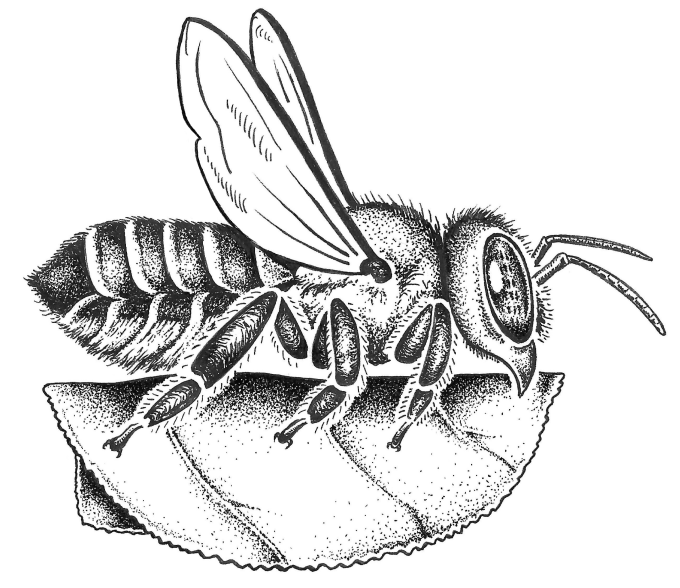
Brachymelecta are one such group of cuckoo bees. They are very large, about bumble bee sized, and a bit wasp looking, with black and yellowish markings on the abdomen.
This group is restricted to North America and Mexico, being found across the majority of the US and a bit into Canada. There are more than 180 species total.
The discovery of Brachymelecta is kind of a weird story.
A weird whitish bee sat in an entomology collection for almost a century as the only one of its kind ever found. It was not labelled well and didn't have info about where it was caught (other than in Nevada possibly) or who caught it when in was collected in the 1870s. No one knew what it was. In 2021 someone finally confirmed that this was not an unidentified species, that it was actually an albino that was the same as a previously identified group! It just happened to look so different from the others.
Because this albino one was named first, all the other identified similar bees were placed into this original genus - Brachymelecta (this is how naming rules work).
The title of their finding was "BRACHYMELECTA... PREVIOUSLY THE RAREST NORTH AMERICAN BEE GENUS, WAS DESCRIBED FROM AN ABERRANT SPECIMEN...".
"Aberrant bee" is going to be the name of my next band.
There isn't much more information on them out there, they are woefully understudied (like most bees).