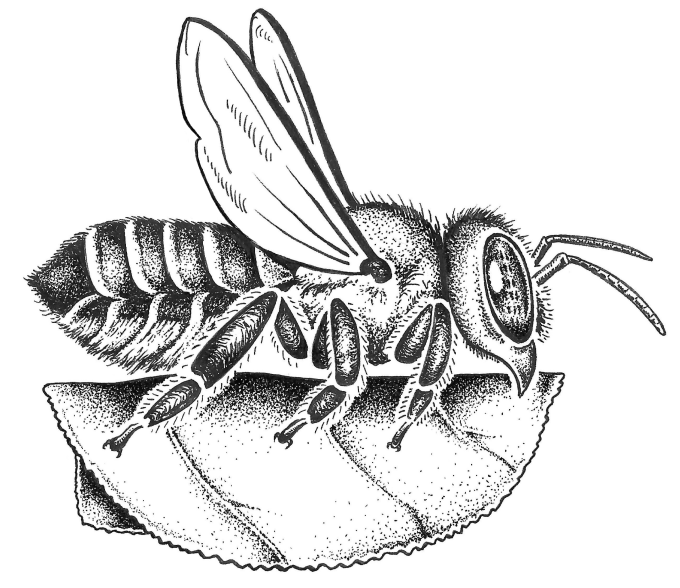
 lucky instar
 random bee: Neofidelia - not skipping leg day
DATE
Welcome to 'random bee', a short writing series where I choose a random page in the book "Bees of the World: A Guide to Every Family" by Laurence Packer, then research it and do a short write up.
DATE
Welcome to 'random bee', a short writing series where I choose a random page in the book "Bees of the World: A Guide to Every Family" by Laurence Packer, then research it and do a short write up.Today's random bee is:
Genus: Neofidelia
Family: Megachilidae
Subfamily: Fideliinae

This genus has a very restricted distribution that is limited to the western deserts of South America. It is mostly only found in northern Chile and southern Peru, living in desert regions including the Atacama desert, although some live at high altitudes also. There are only 5 species in this genus.
Neofidelia are hairy, fuzzy bees, whose hair is originally orangish-colored, but older individuals that are exposed to the sun fade to paler colors. They are medium sized bees at about 9-12 mm in length. They're so hairy they kind of look like bumble bees.
Like other Megachilid bees, females carry pollen on the underside of the abdomen and not on their legs - although they're so hairy they pick up pollen all over their body. Neofidelia create shallow nests in the ground, and females provide a dish-shaped pollen mass to each cell, laying the egg into the center of the provision.
Some of the species are specialists on Chilian bell flowers (Nolana spp.), and accordingly have very long tongues to reach the nectar in these tube-shaped flowers. There is one species, Neofidelia profuga, that is more broadly distributed and is more of a diet generalist - it has a shorter tongue.
Fog oases:
There is a special ecosystem on the Chilean coast called fog oases. When damp air from the Humboldt Current blows over a raised projecting mass of land, it creates a fog oasis when there is a valley-like area surround by high hills. This habitat is always wet, even without rain. One species of Neofidelia is known to only exist in this fog oasis environment.
Males are ripped:
Male Neofidelia have an interesting physiology with giant "thighs" on their back legs. This leg region is called the hind femora. They look like they went to the gym for leg day only. What are the thick thighs for? I don't think we know. Presumably to impress females.